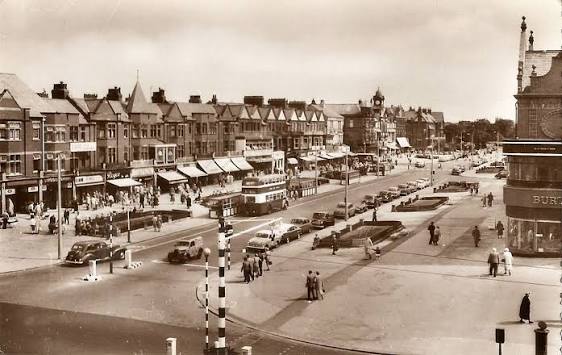
In March 1875 the foundation stone of the St Annes Hotel was laid, and a garden city began among the sand dunes. Our building went up the following year. The pier opened in 1885. The club came in 1897. For most of that time, the town was still deciding what it was going to be.
The night of the Mexico
On 9 December 1886, in a violent gale, the German barque Mexico was driven onto the sandbanks of the Ribble estuary. Three lifeboats launched. Southport's Eliza Fernley was lost. St Annes' own Laura Janet was lost with every one of her thirteen men. Twenty-seven lifeboatmen died in a single night, the worst disaster in the history of the RNLI. Lytham's Charles Biggs reached the Mexico and took off all twelve of her crew.
Sixteen widows and some fifty children were left behind in a town that barely existed. A monument to the Laura Janet's crew was raised by public subscription and unveiled on the promenade in May 1888, an over-life-size lifeboatman looking out to sea. He is still there.
The men who founded this club eleven years later had all lived through that night.
The man who invented the street collection
Charles Macara had moved to St Annes in 1884. A Manchester cotton magnate and chairman of the town's lifeboat branch, he was appalled that the families of the lost were dependent on charity that nobody had organised. On 1 October 1891 he staged the first Lifeboat Saturday in Manchester: bands, floats, and lifeboats hauled through the streets, with 30,000 people watching and over £5,000 raised.
It was the first charity street collection anywhere in the world. Every rattling tin since traces back to a St Annes man's response to a St Annes disaster.
A green heart
The town's gardens were laid out in 1874 as St George's Gardens, nearly lost to housing in the 1890s, and saved by Lord Ashton's money. They reopened as Ashton Gardens in 1916, in the middle of a war. Each November the club's President walks there and lays a wreath at the cenotaph.
Still here
Lytham and St Annes were administered separately for forty-four years before merging into one borough in 1922. The pier lost its Moorish Pavilion to fire in 1974 and its Floral Hall in 1982. The town gained a statue of Les Dawson in 2008 and hosts what is now the largest kite festival in the United Kingdom.
The club has watched all of it from the same address since 1931.
Sources: RNLI; Lytham Heritage Group; Historic England; amounderness.co.uk; Fylde Council; club records.