On Saturday 23 May 1931, the Mayor of Lytham St Annes, Councillor W. Ingham, opened a door on Clifton Drive South and the District Club came home.
The Lytham St Annes Express reported it that Friday under a headline that has aged well: Old School Converted Into Fine New Club. The members, the Mayor told the room, had achieved two great objects. They had turned a derelict building into a beautifully appointed place, and they had a splendid bowling green - the only club in the borough, he believed, of that type with a green attached.
The second object was less about brick and more about air. Members who had spent a busy day in the smoky towns and cities could come to a club by the sea and seek rest and recreation. It is a description of the place that still fits, ninety-five years on.
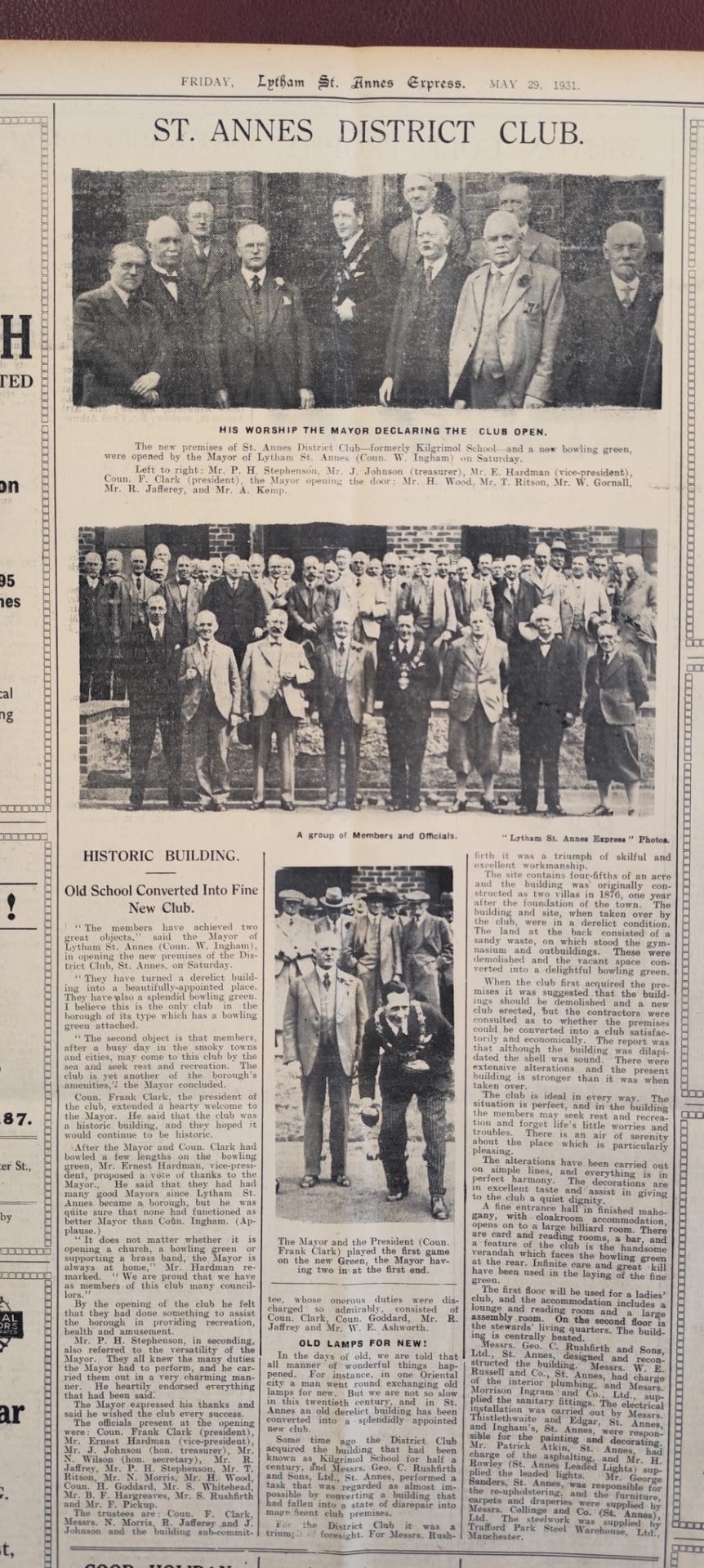
Councillor Frank Clark, the club's President, welcomed the Mayor and said the club was a historic building, and that they hoped it would continue to be historic. Then the two men went out to the new green and bowled a few lengths. The Mayor, the paper noted with evident approval, had two in at the first end.
What they took on
The site runs to four-fifths of an acre. The building had stood since 1876, a year after the founding of the town, and had been Kilgrimol School for half a century. By the time the club acquired it, both building and site were derelict. The land at the back was a sandy waste, and on it stood the school's gymnasium and outbuildings.
There was a serious proposal to knock the whole thing down and build a new club from scratch. Contractors were asked instead whether the premises could be converted satisfactorily and economically. Their report was that although the building was dilapidated, the shell was sound. The alterations that followed were extensive enough that the Express could write that the building was by then stronger than it had been when the club took it over.
The gymnasium and outbuildings came down. The sandy waste behind them became the bowling green.
What they made
A fine entrance hall in finished mahogany opening onto a large billiard room. Card and reading rooms. A bar. And what the paper called a feature of the club - a handsome verandah facing the green.
The first floor was given over to a ladies' club, with a lounge, a reading room and a large assembly room. The stewards' living quarters were on the second floor. The building was centrally heated.
The work was almost entirely local. Messrs Geo. C. Rushfirth and Sons Ltd of St Annes designed and reconstructed the building; W. E. Russell and Co. did the plumbing; Morrison Ingram and Co. supplied the sanitary fittings; Thistlethwaite and Edgar handled the electrical work; Inghams painted and decorated; Patrick Atkin laid the asphalt; H. Rowley of St Annes Leaded Lights made the leaded lights; George Sanders re-upholstered; and Collings and Co. supplied the furniture, carpets and draperies. Only the steelwork came from further afield, from Trafford Park in Manchester.
The men who did it
The officials at the opening were Councillor Frank Clark, President; Ernest Hardman, Vice-President; J. Johnson, Honorary Treasurer; N. Wilson, Honorary Secretary; and R. Jaffrey, P. H. Stephenson, T. Ritson, N. Morris, H. Wood, Councillor H. Goddard, S. Whitehead and F. Pickup. The trustees were Councillor Clark and Messrs N. Morris, R. Jaffrey and J. Johnson. The building sub-committee, whose onerous duties the paper judged to have been discharged admirably, was Councillor Clark, Councillor Goddard, Mr Jaffrey and Mr W. E. Ashworth.
Several of those names are on the honours board to this day.
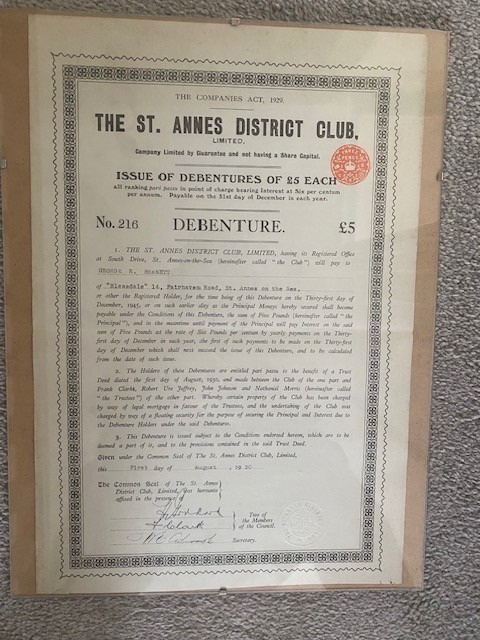
One unsettled question
The Express of 1931 states that the building was originally constructed as two villas in 1876, and the commemorative plaque inside the club says the same. Yet the club's own historian argues the opposite: that John Allen built Kilgrimol School purpose-built on an isolated site among the sandhills, and that the plan of the building - one entrance, one hall, one dormitory - is the plan of a school and not of a pair of semi-detached houses.
Both cannot be right, and the club does not yet know which is. The contemporary report and the plaque agree with each other; the architecture argues back. We have set out the evidence and left the question open, which seems more honest than choosing.
If you know something that settles it, the club would be glad to hear from you.
Source: the Lytham St Annes Express, Friday 29 May 1931 - 'St Annes District Club: Old School Converted Into Fine New Club'. Photographs by the Lytham St Annes Express. With thanks to Steve Singleton.